Human Anchoring: A Meditative Study in the Heart of Hong Kong
Photography, for me, is first and foremost a quest for anchoring. It is the visual journal that attempts to capture that invisible bond which nourishes our souls and profoundly unites beings, regardless of absence or distance. It is in this approach that I align with the spirit of humanist masters. Robert Doisneau, with his ability to reveal the discrete poetry of the Parisian ordinary, and Vivian Maier, whose work is a meditative study of human presence, are guiding lights. They inspire me to seek, not the crowd, but the individual, the intimate point of contact within the world’s tumult.
Human Anchoring
Photography, for me, is first and foremost a quest for anchoring. It is the visual journal that attempts to capture that invisible bond which nourishes our souls and profoundly unites beings, regardless of absence or distance. It is in this approach that I align with the spirit of humanist masters. Robert Doisneau, with his ability to reveal the discrete poetry of the Parisian ordinary, and Vivian Maier, whose work is a meditative study of human presence, are guiding lights. They inspire me to seek, not the crowd, but the individual, the intimate point of contact within the world’s tumult.
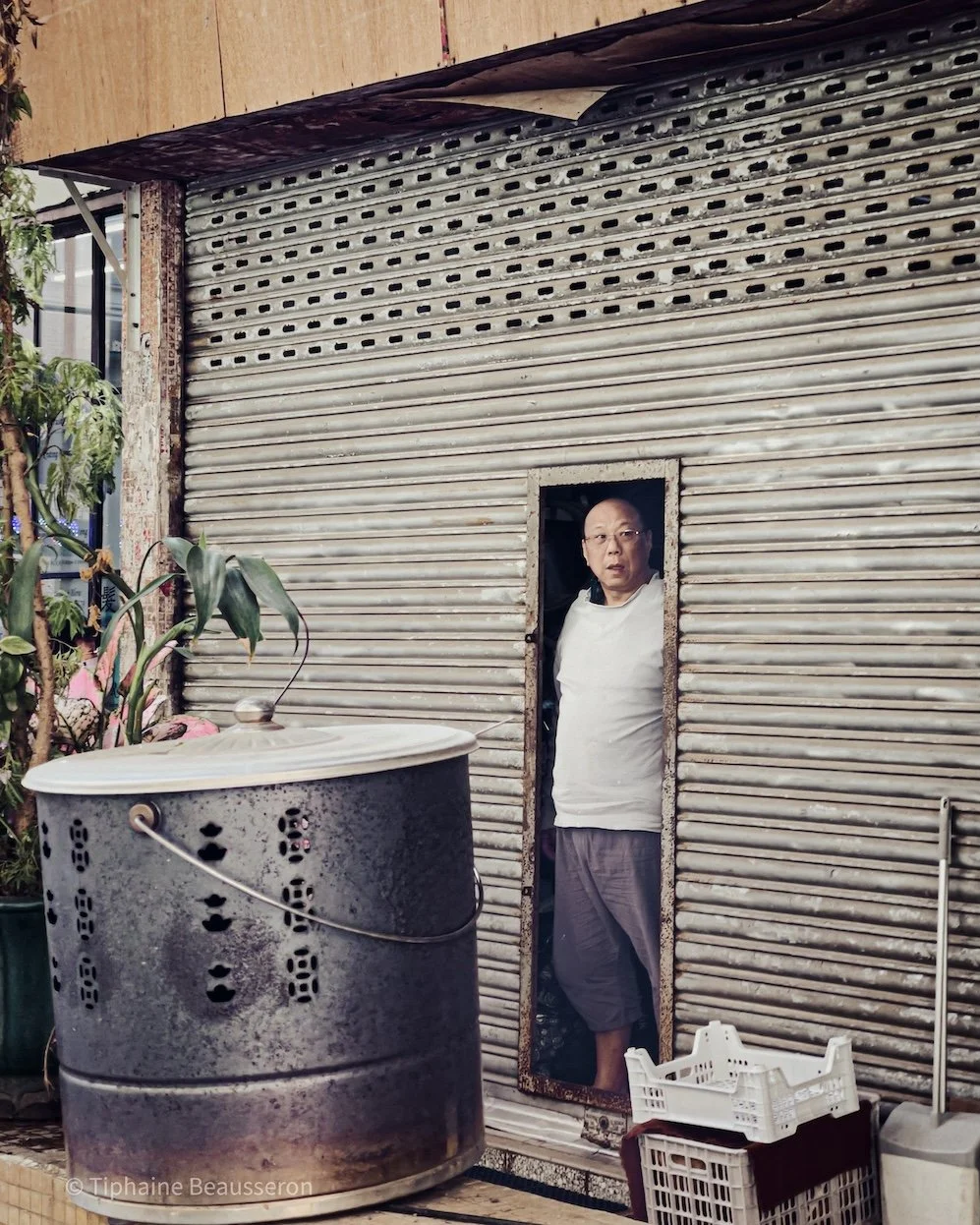
This is how this scene imposed itself upon me in a Hong Kong alley. A city where interconnection is often virtual, where the material dictates the rhythm, and where the need to rediscover a Modernist sensibility in the face of effervescence is palpable.
(shot on Olympus iPhone 12 Pro in December 2024)
The Poetic Minimalism of Composition
The strength of this image lies in its poetic minimalism. The urban architecture, made of cold metal and repetitive horizontal lines, offers a striking contrast. The steel shutter, a symbol of transaction and concealment, paradoxically becomes the setting for the human element.
The composition is a demonstration of the power of the frame within a frame. The subject is literally isolated, extracted from the surrounding agitation. This small opening, this cutout in the facade, is no longer a mere door, but a threshold that confers a dignified presence upon the man. He is the visual and emotional anchoring point. The perspective, by placing him at the center of this rigid structure, underscores the importance of the individual against the mass. He is not overwhelmed by the city; he contains it, he represents it. It is a portrait of the human that persists, that remains, despite the environment.
The Subtle Language of Timelessness
The chromatic treatment of this photograph is an integral part of its narrative. I deliberately sought a patina, a delicacy of tones that evokes aged film and Pictorialism. By desaturating the colors and lending them a subtle warmth, I aim to create timelessness.
This is not a simple vintage effect. It is a philosophical choice: to blur the markers of time so that this man’s gaze, his posture, his story, become universal. Color here becomes a subtle language of visual symbols, suggesting that the themes of humanity, solitude, and connection are eternal. This Hong Kong scene could be that of any city, at any time, because it touches upon the fundamental truth of our condition.
This image is, ultimately, an invitation to the viewer to take part in this intimate narrative process. It questions: what place do we grant to this invisible bond, to this discrete poetry of existence, in our age of artificial intelligence and virtual connection? It reminds us that the true wealth of a city is measured by the depth of its inhabitants’ gaze.
Find these photos also on Instagram and Foto
L’Ancrage Humain : Une Étude Méditative au Cœur de Hong Kong
La photographie, pour moi, est une quête de l’ancrage. Elle est le journal visuel qui tente de saisir cet invisible liant qui nourrit nos âmes et unit profondément les êtres, par-delà l’absence ou la distance. C’est dans cette démarche que je rejoins l’esprit de maîtres humanistes. Robert Doisneau, avec sa capacité à révéler la poésie discrète de l’ordinaire parisien, et Vivian Maier, dont l’œuvre est une étude méditative de la présence humaine, sont des phares. Ils m’inspirent à chercher, non pas la foule, mais l’individu, le point de contact intime dans le tumulte du monde.
C’est ainsi que cette scène s’est imposée à moi au pied des Monster Buildings du Quarry Bay à Hong Kong.
Le Minimalisme Poétique de la Composition
La force de cette image réside dans son minimalisme poétique. L’architecture urbaine, faite de métal froid et de lignes horizontales répétitives, offre un contraste saisissant. Le rideau de fer, symbole de la transaction et de l’occultation, devient paradoxalement l’écrin de l’humain.
La composition est une démonstration de la puissance du cadre dans le cadre. Le personnage est littéralement isolé, extrait de l’agitation. Cette petite ouverture, cette découpe dans la façade, n’est plus une simple porte, mais un seuil qui confère une présence digne à l’homme. Il est le point d’ancrage visuel et émotionnel. La perspective, en le plaçant au centre de cette structure rigide, souligne l’importance de l’individu face à la masse. Il n’est pas submergé par la ville ; il la contient, il la représente. C’est un portrait de l’humain qui persiste, qui demeure, malgré l’environnement.
Le Langage Subtil de l’Intemporalité
Le traitement chromatique de cette photographie est une partie intégrante de son récit. J’ai volontairement recherché une patine, une délicatesse des tons qui évoque l’argentique et le Pictorialisme. En désaturant les couleurs et en leur conférant une chaleur subtile, je cherche à créer une intemporalité.
Ce n’est pas un simple effet vintage. C’est un choix philosophique : estomper les marqueurs du temps pour que le regard de cet homme, sa posture, son histoire, deviennent universels. La couleur devient un langage subtil de symboles visuels, suggérant que les thèmes de l’humain, de la solitude et du lien sont éternels. Cette scène de Hong Kong pourrait être celle de n’importe quelle ville, à n’importe quelle époque, car elle touche à la vérité fondamentale de notre condition.
Cette image est, en définitive, une invitation au spectateur à prendre part à ce processus narratif intime. Elle interroge : quelle place accordons-nous à ce lien invisible, à cette poésie discrète de l’existence, dans notre ère de l’intelligence artificielle et de la connexion virtuelle ? Elle nous rappelle que la véritable richesse d’une ville se mesure à la profondeur du regard de ses habitants.